Participation Volumes Fueling Escalations in Progressive Slot and Bingo Jackpots
Written by Anna Powell · Jun 23, 2026
Participation Volumes Fueling Escalations in Progressive Slot and Bingo Jackpots
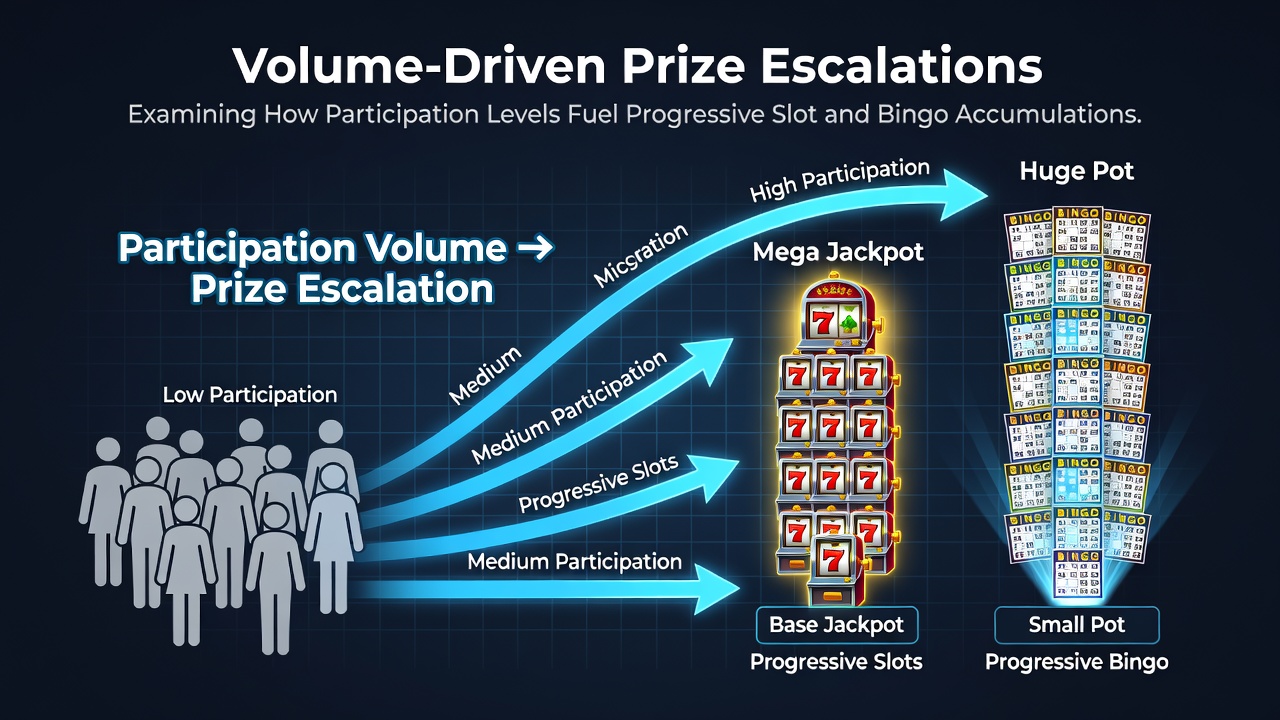
Progressive jackpots in slots and bingo grow through contributions from player wagers, and higher participation volumes accelerate the rate at which these pools expand across networked systems. Each bet placed in eligible games directs a fixed percentage into the accumulating prize, creating a direct link between the number of active participants and the speed of escalation. Observers note that systems with greater engagement reach higher thresholds faster than those with sporadic activity.
Mechanics of Progressive Accumulations
Operators configure progressive slots and bingo variants so that a portion of every qualifying wager feeds into one or more prize pools, and these pools connect across multiple machines or online sessions in linked networks. When participation rises, the frequency of contributions increases, which compounds the total faster while the base game continues to award smaller wins separately. Data from regulatory filings shows that linked progressives often exceed stand-alone versions in growth velocity because contributions arrive from wider player bases simultaneously.
Impact of Player Numbers on Growth Rates
Higher volumes of concurrent players produce more wagers per hour, and this volume directly scales the size of increments added to the jackpot meter. Researchers tracking system logs have documented cases where doubling the number of active terminals or sessions roughly doubles the hourly addition to the pool, assuming consistent bet sizes. Bingo rooms that run multiple simultaneous games with shared progressives demonstrate similar patterns, where ticket sales volume determines how quickly the accumulation climbs toward payout triggers.
Thresholds and Trigger Conditions
Many progressive formats set payout triggers at random intervals or after specific contribution milestones, and elevated participation shortens the time between these events. In June 2026, aggregated platform reports indicated that networks with above-average daily active users reached major payout stages weeks earlier than comparable low-volume setups. The relationship remains mathematical rather than probabilistic in isolation, because each additional player adds measurable increments regardless of individual outcomes.
Bet level requirements further modulate the effect, since only wagers meeting minimum thresholds contribute to the progressive component. Systems that attract players willing to meet those levels sustain faster escalations, while lower-stake environments accumulate more gradually even with high headcounts.

Networked Systems and Geographic Reach
Wide-area progressives link machines or sessions across regions, pooling contributions from diverse player populations, and this structure magnifies the volume effect beyond single-site limits. Reports from the Nevada Gaming Control Board illustrate how interstate or international linkages produce larger base pools that escalate more rapidly during peak activity periods. Bingo operators have adopted comparable multi-venue models, where ticket purchases from separate halls feed shared accumulations and create synchronized growth curves.
Seasonal fluctuations in participation create visible variations in escalation speed, with holiday periods or promotional windows driving temporary spikes that push meters higher within days rather than weeks. Platform analytics reveal that these surges often coincide with increased average bet sizes, compounding the volume-driven additions further.
Comparative Data Across Formats
Studies compiled by the Victorian Commission for Gambling and Liquor Regulation compare progressive slot networks against bingo accumulations and find that both respond proportionally to participation density, though bingo systems sometimes incorporate fixed ticket contributions that stabilize baseline growth. Slots tend to show sharper accelerations during high-traffic intervals because reel spins occur at higher frequency than bingo draws. Observers tracking both formats note that the underlying contribution mechanics remain consistent even as surface gameplay differs.
Operators adjust contribution percentages and linkage scopes to balance jackpot appeal against payout frequency, and volume projections inform these decisions. Higher expected participation justifies larger networks or slightly elevated contribution rates, while lower projections favor tighter pools to maintain visible growth momentum.
Conclusion
Participation levels determine the pace and scale of progressive prize escalations in slots and bingo because each additional wager supplies a measurable increment to the shared pool. Network architecture, bet thresholds, and geographic reach all interact with volume to shape final outcomes, and data collected through 2026 continues to confirm this relationship across regulated markets. The structure of these systems ensures that sustained engagement produces larger accumulations over defined time frames.